The short answer
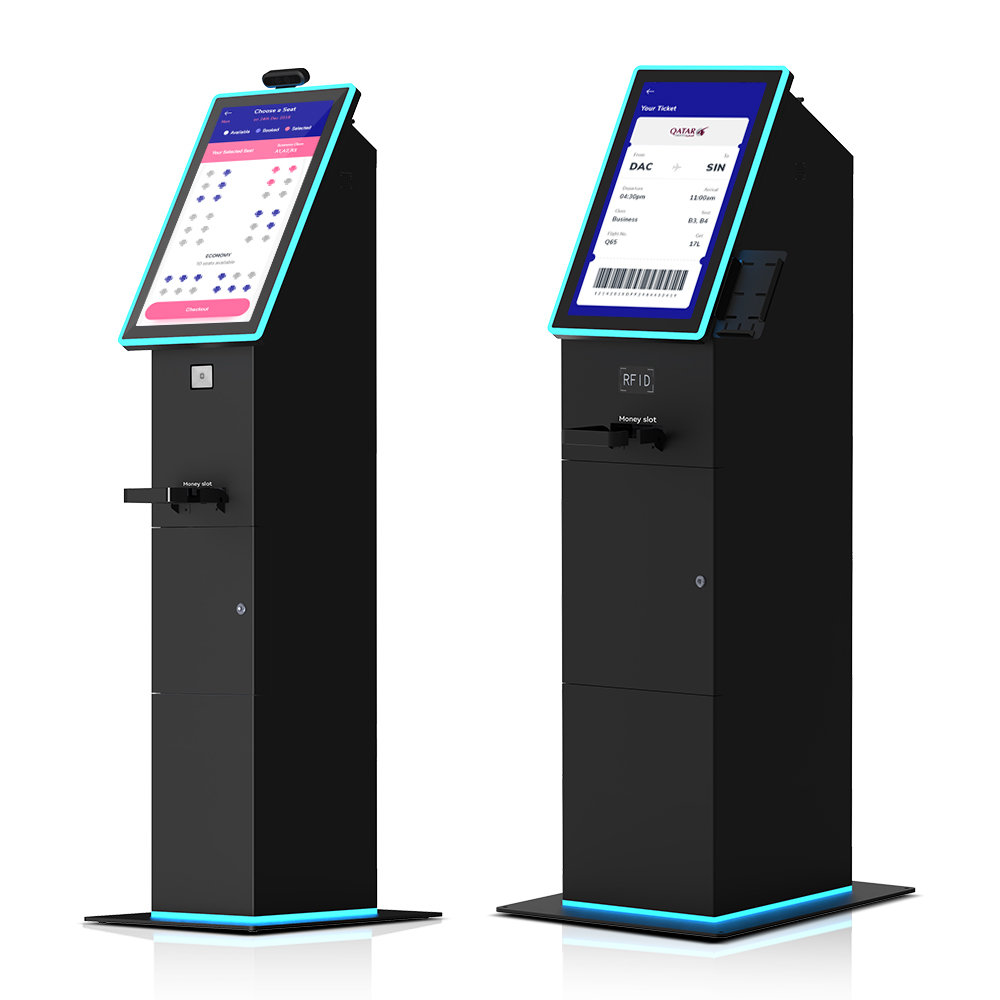
A cash-dispensing kiosk for a gaming venue is not a generic ATM. It must handle high-volume, multi-denomination cash-out, run 7×24 without downtime, fit your floor layout for replenishment, and — critically — pass the jurisdictional compliance path your license requires (for self-service kiosks that path is typically GLI-20, with ticket validation governed by GLI-11/GLI-13). The US-K236CB is a 23.6″ freestanding cash-handling kiosk built for exactly this profile: multi-brand cash dispensers, up to 6 cassette positions, front/rear/dual-service access, Android/Windows/Linux compute, and OEM/ODM branding so the unit ships as your machine, not a white label.
Why gaming operators replace the payout window
On the floor, a cashier cage creates four recurring costs: queues during peak play, staffing around the clock, downtime when a single dispenser jams, and audit exposure on every cash movement. A self-service cash-out node moves redemption off the window and onto the floor, where the player controls the interaction and your staff only handles replenishment.
Operator pain → what the machine delivers
| Operational pain | US-K236CB capability | What the operator gains |
|---|---|---|
| Payout window queues during peak hours | 23.6″ flat 10-point capacitive touch, 1920×1080 | Players self-serve; window pressure drops, dwell experience improves |
| Multi-denomination, high-value payouts | Up to 6 cassette positions (2 standard), 500/1000-sheet options | One unit covers more denominations; fewer replenishment trips |
| Venue runs 24/7, cannot stop | 7×24 continuous operation, 0–40°C, AV100–240V | Holds up through night shifts and weekend peaks |
| Replenishment disrupts player traffic | Front / rear / dual-service access | Wall-placed or island-placed, service without stopping the floor |
| Dispenser spares and failure risk | Fujitsu F53/F56, GRG CDM-6240N, or Puloon dispenser options | Global spares path and a genuine alternative, not a single-source gamble |
| Cash audit and internal-loss control | Validation-system integration required for ticket redemption (see GLI-20 below) | Ticket status updated to “Redeemed” on cash-out, blocking duplicate payout |
| Player identity / loyalty | NFC: 125K ID / 13.56M IC, Mifare1, ISO14443-A | Member card, room key, or wristband integration |
| Vouchers and receipts | 58/80 mm receipt printer, 1D/2D scanner, POS bracket | Print proof of payout, scan vouchers, issue physical receipts |
| Brand control | OEM/ODM: enclosure, hardware, peripherals, branding | Delivered as your branded unit |
| Integration with your platform | Android 11/13/14/16, Windows 10/11, Linux Debian/Ubuntu; Intel I3/I5/I7/J6412 or Rockchip RK3568/3576/3588 | Existing platform connects without a ground-up rewrite |
| Trial before scale | MOQ 1 unit; lead time 20–25 business days | Pilot a few units, then scale |
Three ways venues deploy it
- Cash-out / redemption point. Players convert value to cash on the floor instead of walking to the cage.
- High-limit and VIP areas. Six cassettes support multi-denomination, higher-value payouts, reducing replenishment frequency.
- 24-hour zones (slot floors, electronic table areas). Unattended operation lets you cut overnight staffing to a minimum.
Compliance is the first gate — the GLI-20 checklist
Before hardware, gaming procurement asks one question: what standard does this kiosk have to meet? For self-service kiosks, the relevant framework is GLI-20 (Standards for Kiosks). Confirm the current version with your testing lab — published versions include v1.4 (2006), v1.5 (2011-09-06), and V2.0 (2019). Related standards you will encounter: GLI-11 (Gaming Devices), GLI-13 (Monitoring & Control / Validation systems), GLI-16 (Cashless systems), and GLI-33 (Sports Wagering). Jurisdiction-specific regimes (UKGC, Italian AAMS, WLA-SCS, and state codes) sit on top. Some regulators adopt GLI-20 by reference — for example, Massachusetts 205 CMR 138 incorporates GLI-20 v1.5.
GLI-20’s hard requirements for a kiosk include:
| GLI-20 requirement | What it means for your build |
|---|---|
| Tamper-evident identification badge on the cabinet | Non-removable, removal-evident badge showing manufacturer name and a unique serial number |
| Configurable transaction limits | Separate limits for ticket issuance and ticket redemption, set through a secure method; final limits are set by the local gaming commission |
| Validation-system integration (per GLI-11 / GLI-13) | When a ticket is redeemed for cash at the kiosk, its status must update to “Redeemed” in real time — the core anti-duplicate-payout control |
Important distinction: a cash-out/redemption kiosk and a betting-acceptance terminal are governed differently (GLI-20 vs GLI-33). Confirm which classification your project falls under before specifying hardware.
De-risking the project
- Certification. We have not published a GLI-20 or GLI-11 certificate for the US-K236CB. Certification is achieved per jurisdiction by an independent test lab (ITL) such as GLI or BMM Testlabs; Usingwin supports that process with the hardware and documentation the lab requires. Do not treat this article as a claim of existing certification.
- Dispenser selection. Confirm the exact dispenser model, cassette count, and audit features against your current spec sheet before order — module parameters change between generations and we do not republish unverified figures here.
- Redeem vs. disperse. If your primary need is ticket redemption/voucher payout, the US-K236CB-1 curved cabinet is positioned for gaming & redemption; the US-K236CB itself is positioned for cash handling across gaming and banking/finance. Match the model to the job.
Next step
Send us your jurisdiction, the standards your license references, and your denomination/payout profile. We will return a configuration proposal and a datasheet for the exact dispenser and cassette setup, and confirm what the certification path requires. Request a quote and the US-K236CB specification sheet →
FAQ
Does the US-K236CB come GLI-20 certified?
No certificate is published for this model. Certification is granted per jurisdiction by an independent test lab (GLI, BMM); Usingwin provides the hardware and documentation needed for that testing.
How many cash cassettes does it hold?
Up to 6 cassette positions, with 2 standard, and 500- or 1000-sheet cassette options. Confirm against the current datasheet for your configuration.
Can it run our own software?
Yes. Compute is configurable across Intel I3/I5/I7/J6412 or Rockchip RK3568/3576/3588, with Android 11/13/14/16, Windows 10/11, or Linux Debian/Ubuntu.
What is the minimum order?
MOQ 1 unit, with a 20–25 business-day lead time.
Leave a Reply